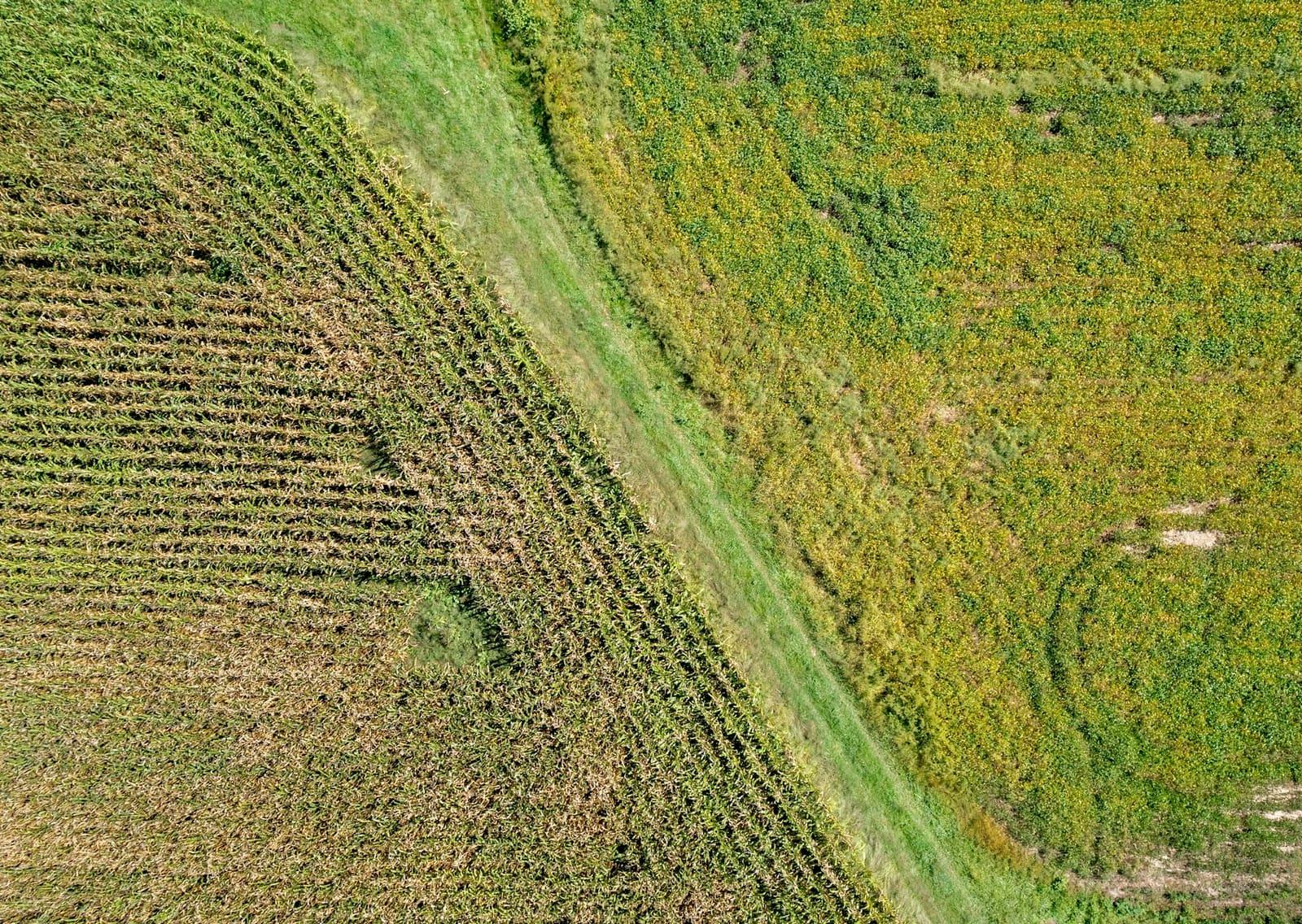
Crop and weed similarity
Look-alike species share colour, texture and leaf shape, especially when young.
Agricultural AI Research
Investigating crop and weed image generation, annotation quality and robust perception across diverse agricultural environments.
Research direction. Imagery is schematic; no datasets or benchmark results are published yet.
Research challenges
Seven sources of difficulty the research is designed to separate and measure.
Look-alike species share colour, texture and leaf shape, especially when young.
Sun angle, shadows and glare change appearance throughout the day.
Colour, residue and canopy change across the season.
Seedlings and mature plants are effectively different visual classes.
Soil colour, moisture and residue cover alter contrast with plants.
Pixel-level labels are slow to produce and rarely cover every condition.
Models trained on one region or cultivar may fail on another.
Experimental pipeline
The intended experimental pipeline; real and synthetic sources follow the same validation and evaluation steps.
STEP 01
Licensed field imagery or a parameterised scenario description.
STEP 02
Generate variations, or select real images to cover target conditions.
STEP 03
Pixel-level classes from scene ground truth or annotators.
STEP 04
Check class consistency, boundaries and empty or merged regions.
STEP 05
Field-level splits so no farm appears in both training and test.
STEP 06
Per-class and per-condition metrics on held-out real imagery.
STEP 07
Inspect look-alike confusions and condition-specific misses.
Dataset explorer
One schematic dataset sample viewed five ways. It explains how pixel-level labels and dataset metadata fit together. Static fixture — not a real field image.
Illustrative Dataset Explorer — Static Schematic Fixture
Illustrative DemonstrationThe full mask: each pixel holds exactly one class index — soil 0, crop 1, weed 2.
Pixel-level labels
A segmentation mask is an image the same size as the input, where each pixel stores a class index instead of a colour. Colours here are only for display.
Dataset structure
dataset/
  images/      RGB samples
  masks/       class-index PNGs
  splits/      field-level train/val/test lists
  metadata.json
  dataset_card.md
Static fixture: one original schematic sample and an example record. It is not a real field image and not part of a published dataset.
Scenario variation
Vary lighting, growth stage and task to see how the scenario description and what it tests change. Illustrative only: no generative model or field simulation runs in your browser.
Illustrative Scenario Variation — Not a Live Simulation
Illustrative Demonstrationlighting=low · stage=early · task=weed
This variation combines small seedlings that look most like weeds with long shadows that can be mistaken for plants. It tests how many weeds are missed or confused with crops.
Illustration only. No generative model, field simulation or dataset generation runs in your browser.
Research evaluation
Metrics and comparisons the research uses. Benchmark values will be published only when verified and approved — none are yet.
|A ∩ B| / |A ∪ B|2 |A ∩ B| / (|A| + |B|)TP/(TP+FP), TP/(TP+FN)metric | lighting, stage, fieldreal-only vs real+syntheticagreement, flagged masksSuitability depends on context. TP, FP and FN are true positives, false positives and false negatives; A and B are predicted and reference regions. A metric that suits detection may mislead for segmentation, and class imbalance, label quality and the cost of each error type all change which measures matter.
Comparison protocol
Evidence: Unavailable · R-008What changes
Trained on real labelled field images only.
Held fixed
Field-level splits, architecture, budget, seeds.
Question answered
What does real data alone achieve?
Results matrix
| Configuration | IoU (crop) | IoU (weed) | Dice | Precision | Recall |
|---|---|---|---|---|---|
| Real-only baseline | No verified result | No verified result | No verified result | No verified result | No verified result |
| Real + synthetic | No verified result | No verified result | No verified result | No verified result | No verified result |
| Synthetic-only | No verified result | No verified result | No verified result | No verified result | No verified result |
| Unseen-farm test | No verified result | No verified result | No verified result | No verified result | No verified result |
No results are published: no experiment has been verified and approved in the evidence register. Values will appear here only when they are.
Applications
Research relevance, not deployments. Outputs listed are technical artefacts a study could produce.
Mapping crop cover and weed pressure at fine resolution.
Possible research output
Perception for robots operating in variable field conditions.
Possible research output
Separating weeds from crops at close range.
Possible research output
Tracking growth stage and canopy over time.
Possible research output
Investigating visible stress indicators with agronomists.
Possible research output
Research project
If you work with field imagery, agricultural robots or crop models, we would like to discuss research questions where better data could be tested properly.